

Table of Contents
- Best Professional DTF Starter Kits 2026: What Actually Ships in the Box
- Quick Comparison: Professional DTF Starter Kits at a Glance
- Prestige R2 Pro Shaker Bundle: The Turn-Key Production System
- Prestige A4 DTF Printer: Entry-Level DTF Printing Under $3,000
- xTool Apparel Printer All-in-1 Bundle: One-Click Workflow Automation
- Building a Reliable Heat Press for Small Business DTF Production
- Commercial DTF Printing Workflow: From RIP Software to Post-Wash Durability
- DTF Printer Maintenance Tips: Clogging Prevention and Printhead Care
- Frequently Asked Questions
Last Updated: October 2, 2026
Best Professional DTF Starter Kits 2026: What Actually Ships in the Box
Shopping for the best professional DTF starter kits 2026 has to offer means reading past the headline price.
A DTF starter kit is a bundled package that combines a direct-to-film printer with the supporting equipment needed to finish a transfer, typically a powder shaker or curing oven, RIP software, film, ink, and hot melt adhesive powder.
Below, we break down what each professional kit actually includes, who it fits, and where the hidden costs sit.
Quick Comparison: Professional DTF Starter Kits at a Glance
The three kits below cover the realistic range for a professional shop, from a compact desktop unit to a full production bundle.
| Kit | Price | Print Speed | Printheads | Best For |
|---|---|---|---|---|
| Prestige R2 Pro Shaker Bundle | $10,784.99 | 30-35 sq. ft./hour | Dual Epson i1600 | Scaling production shops |
| xTool Apparel Printer All-in-1 | $8,799.00 | Not published | Dual Epson i1600 | Automated one-click workflow |
| Prestige A4 DTF Printer | $2,995.00 | 9 sq. ft./hour | Epson L805 | Entry-level and test runs |
Two things stand out. First, the price gap between entry and production grade is roughly three to four times, not a small step up. Second, speed scales with printhead count, not with brand marketing.

Prestige R2 Pro Shaker Bundle: The Turn-Key Production System
This is the kit we recommend first for shops that already have orders to fill. The Prestige R2 Pro Shaker Bundle is a complete direct-to-film production system built around dual Epson i1600 printheads, and it ships with a powder shaker and dryer, DigiRIP RIP software, Color Prime DTF ink, film, hot melt powder, and cleaning supplies in one purchase.
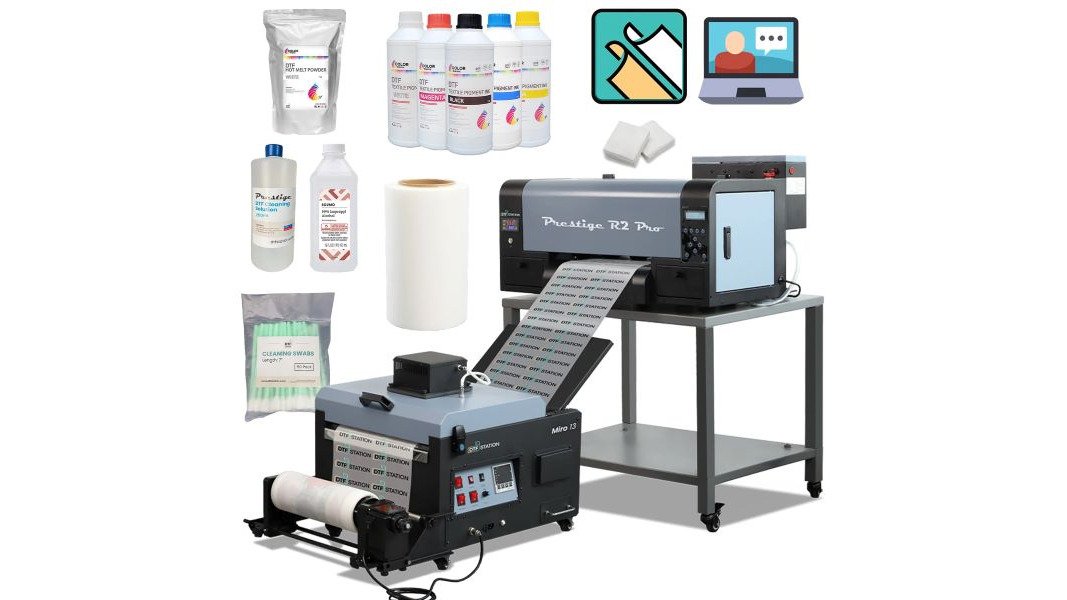
Dual Epson i1600 Printheads and 30-35 Sq. Ft. Per Hour Throughput
Production throughput is where this machine separates itself from entry-level units.
Two features matter for uptime.
The bundle comes in two configurations. The Intermediate Package pairs the printer with a Miro 13 Max shaker and dryer.
Training is mandatory on this machine. Virtual training is included; on-site training runs an additional $2,750.
A fair limitation: at 125 lbs, this is a desktop-sized machine but not a benchtop afterthought.
Prestige A4 DTF Printer: Entry-Level DTF Printing Under $3,000
Not every shop needs production volume on day one. The Prestige A4 DTF Printer is the smallest unit DTF Station makes, and at $2,995.00 it is the cheapest way into professional direct-to-film printing without buying hobby-grade hardware.

What you give up in speed, you get back in footprint. At 23" x 10" x 8.3" and 22.71 lbs, it fits on a standard workbench.
Warranty terms are worth reading closely. The A4 carries a limited one-year warranty on non-consumable parts and a limited six-month warranty on up to one printhead.
Where this printer fits: shops testing DTF demand, promotional product businesses adding custom apparel, and anyone who wants to learn the workflow before committing to a production machine.
xTool Apparel Printer All-in-1 Bundle: One-Click Workflow Automation
Automation is the entire pitch here, and for high-volume apparel work it is a legitimate one. The xTool Apparel Printer All-in-1 Bundle pairs a dual Epson i1600 printhead printer with the xTool OS1 Automatic Shaker Oven, creating a connected workflow that runs from printing through curing with minimal manual handling.

The automation features are specific rather than vague. Automatic film cutting removes a manual step. Precise powder distribution replaces hand-shaking powder onto wet ink.
The bundle ships complete: CMYKW ink at 500 ml per channel, 25 m of DTF printing film, 500 ml of film pre-treatment solution, hot melt adhesive powder, a smoke exhaust pipe, and the xTool SafetyPro AP2.
The tradeoff is price and openness. At $8,799.00 it sits close to the R2 Pro, and the integrated workflow works best when you stay inside the xTool ecosystem.
Building a Reliable Heat Press for Small Business DTF Production
A reliable heat press for small business DTF production is the piece most buyers underestimate. The printer gets all the attention, but every transfer you sell passes through the press, and inconsistent pressure or temperature shows up as peeling graphics six weeks later.
Prestige R2 Pro Shaker Bundle →
Three specifications decide whether a press holds up under daily DTF work:
- Even pressure across the platen. DTF transfers need consistent medium pressure. A press with a warped or weak platen produces transfers that adhere at the center and lift at the edges.
- Accurate, stable temperature. Transfer temperatures for DTF film sit in a narrow band, and curing powder needs its own range. A press that drifts 20 degrees between cycles will produce inconsistent results.
- Duty cycle. A press rated for occasional craft use will not survive eight hours a day of production. Look at the frame construction and the heating element rating, not the marketing copy.
Pair the press with the right film and the workflow gets easier. The Color Prime Glide DTF Film Roll allows instant peel right after transfer, with a suggested transfer range of 266-284°F for 10-15 seconds and curing at 257°F. For high-volume shops, the Audley 24" x 328FT DTF Film presses at approximately 300°F with a hot peel in about three seconds, which clears the press faster on large orders.
Commercial DTF Printing Workflow: From RIP Software to Post-Wash Durability
A commercial DTF printing workflow runs in five stages: RIP software prepares the file, the printer lays down CMYK plus white ink on film, a powder shaker applies hot melt adhesive, a curing oven or shaker-dryer sets the powder, and a heat press transfers the image to the garment.
Each stage has a failure point, and post-wash durability is where most shops get caught. A transfer that looks perfect off the press can crack after three washes if the powder was under-cured or applied unevenly.
The powder choice drives durability more than most operators expect. Audley DTF Powder comes in two grits: Fine at 80-170 microns for detailed graphics and small lettering, and Medium at 100-200 microns for hoodies, workwear, and heavier fabrics that need stronger adhesion. For stretchy fabrics like polyester, Color Prime Flex Hot Melt Powder is formulated for stretchability with a soft hand feel, curing at 300°F or above with a cold peel.
Curing equipment matters just as much. The DTF Station Phoenix Air 16x20 Curing Oven cures transfers in under a minute at 230-248°F with a bottom heating element for even distribution, and it includes a built-in purification system. It handles film sizes up to 16" x 20".
To test durability before you ship a large order, run this check:
- Print, powder, and cure a test transfer
- Press it onto the same fabric blend as the customer order
- Wash it five times on a normal cycle
- Inspect for cracking, lifting, or color loss at the edges
- Repeat with a second powder grit if the first fails
The thing nobody tells you about DTF durability is that most failures trace back to over-powdering, not under-curing. Excess powder that does not fully melt leaves a brittle layer that cracks at the first stretch. Shake off the excess before curing.
DTF Printer Maintenance Tips: Clogging Prevention and Printhead Care
Regular maintenance is what separates a printer that runs for years from one that needs a printhead replacement in six months. White ink is the primary culprit in DTF systems because its pigment settles faster than CMYK.
A practical maintenance cycle looks like this:
- Daily: Run a nozzle check before the first job. Clean the printhead surface and the capping station.
- Weekly: Inspect the waste ink tank and empty it before it overflows. Wipe down the film path.
- Monthly: Flush ink lines if the machine has sat idle, and check the capping station seal for wear.
Ink preparation matters more than most operators realize. Settled pigment causes inconsistent density and can contribute to ink-flow problems. The DTF Station Eddy2 Ink Shaker uses orbital mechanical rotation to re-suspend pigments hands-free, which standardizes the process across shifts instead of relying on whoever shakes the bottle hardest.
For deeper cleaning or when switching ink systems, Image Armor DTG Printer Flushing Solution flushes out DTG and DTF ink lines and printheads, and it is safe for water-based ink formulations. It also works as storage prep if you plan to idle a machine for an extended period.
One more consideration that rarely appears in kit comparisons: firmware and technical support. A printer is only as good as the help available when something fails mid-order. Confirm the warranty terms, the support hours, and whether the vendor stocks replacement parts before you buy.
Choosing the right DTF setup comes down to matching kit capability to actual order volume, not to the biggest spec sheet. The Prestige R2 Pro Shaker Bundle covers shops ready to produce daily, the xTool All-in-1 suits operations that want automation, and the Prestige A4 gets beginners printing without overcommitting.
Frequently Asked Questions
What are the essential components of a professional DTF starter kit?
A complete DTF starter kit includes the printer itself, RIP software such as DigiRIP, transfer film, CMYK+W DTF ink, hot melt adhesive powder, a powder shaker or curing oven, and basic maintenance supplies like cleaning solution and swabs. The Prestige R2 Pro Shaker Bundle, for example, ships with the printer, DigiRIP software, a Miro 13 Max shaker and dryer, Color Prime film, ink, powder, and cleaning tools. Missing any one of these pieces means you cannot run a full print-to-bake cycle on day one.
What is the best DTF printer for beginners in 2026?
The Prestige A4 DTF Printer is the most accessible starting point at $2,995. It uses an Epson L805 printhead, prints at 9 square feet per hour, and fits on a desktop at 23 by 10 by 8.3 inches. It handles cotton, polyester, and PU fabrics, and produces roughly 70 pieces per day on 7.87 by 11.81 inch designs across an 8-hour shift. For beginners who want to learn direct-to-film without committing to a production floor, it is the lowest-risk entry.
How do Roland BY series printers compare to Audley DTF systems?
Roland BY series printers and Audley DTF systems serve different production profiles. Roland BY printers are built for shops that want a branded hardware ecosystem with established support channels. Audley DTF printers are designed around roll-fed production and pair with Audley 24-inch hot peel film, which presses at approximately 300 degrees Fahrenheit and peels in about 3 seconds. The right choice depends on your volume, your existing workflow, and whether you need a 24-inch roll format or a compact desktop footprint.
Is a DTF Station printer suitable for high-volume commercial production?
Yes. The Prestige R2 Pro, a DTF Station printer, handles up to 180 prints per day based on 12 by 14 inch designs across an 8-hour workday. It runs dual Epson i1600 printheads at 30 to 35 square feet per hour, holds 1-liter bulk ink cartridges, and includes a White Ink Management System for consistent white ink circulation. For shops scaling past entry-level output, it is built for commercial DTF printing workflow demands.
What maintenance is required for professional DTF printing equipment?
Daily maintenance includes running a nozzle check, agitating white ink, and wiping the printhead area. The Prestige R2 Pro automates part of this with passive cleaning every 4 hours when idle and active cleaning at set intervals during printing. Weekly tasks include checking the waste ink tank, cleaning the capping station, and using an ink shaker like the DTF Station Eddy2 to re-suspend settled pigments. Properly mixed ink reduces sediment buildup and supports reliable ink flow.


