

Table of Contents
- DTF vs Sublimation for Apparel: The Core Differences
- Fabric Compatibility: The Best Fabric for Sublimation Shirts and DTF Blanks
- Print Feel, Wash Durability, and Color Gamut
- Cost Per Print: DTF vs Sublimation Pricing Breakdown
- Heat Press Settings for DTF Transfers and Sublimation
- DTF Printer Maintenance Tips and Sublimation Upkeep
- Equipment, ROI, and Scaling Your Apparel Business
- Conclusion
- Frequently Asked Questions
Last Updated: September 28, 2026
DTF vs Sublimation for Apparel: The Core Differences
The dtf vs sublimation for apparel decision comes down to one question: does your design sit on the fabric or become part of it? DTF heat-presses a film transfer onto the garment surface; sublimation turns ink into gas and bonds it into polyester fibers. That drives fabric compatibility, feel, and cost per print.
How DTF Transfers Work
DTF printing runs in five steps: a printer lays CMYK plus a white ink layer onto PET film, adhesive powder is applied to the wet ink and cured in a shaker or oven, then a heat press transfers the design and the film peels away.
How Dye-Sublimation Bonds to Fabric
Sublimation skips the transfer layer entirely: a design is printed onto transfer paper with dye-sublimation ink, then pressed at high heat so the ink turns to gas and bonds into the fabric's fibers.

Fabric Compatibility: The Best Fabric for Sublimation Shirts and DTF Blanks
Sublimation requires light-colored fabric with more than 65% polyester content, according to DTF Station Global's 2026 material requirements. DTF has no such restriction. It applies to cotton, polyester, cotton blends, and dark garments alike.
Fabric Type |
Sublimation |
DTF |
|---|---|---|
100% cotton |
Not compatible |
Excellent |
100% polyester (light) |
Excellent |
Good |
Polyester blend (65%+) |
Good |
Excellent |
Dark-colored garments |
Not compatible |
Excellent |
Stretch performance wear |
Excellent |
Good |
Polyester and Cotton Blend Limits
Blends sit in a gray zone: a 50/50 cotton-poly shirt accepts sublimation ink but looks washed out because only half the fibers hold dye. Most decorators treat 65% polyester as the practical floor.
Print Feel, Wash Durability, and Color Gamut
Sublimation wins on feel, there is nothing to feel. DTF wins on color range across fabric types, because its white ink layer lets bright colors appear on dark garments.
Cost Per Print: DTF vs Sublimation Pricing Breakdown
Sublimation costs less per print. DTF costs less per finished garment in many small-run scenarios because it eliminates waste from misprinted sizes and colors.
Heat Press Settings for DTF Transfers and Sublimation
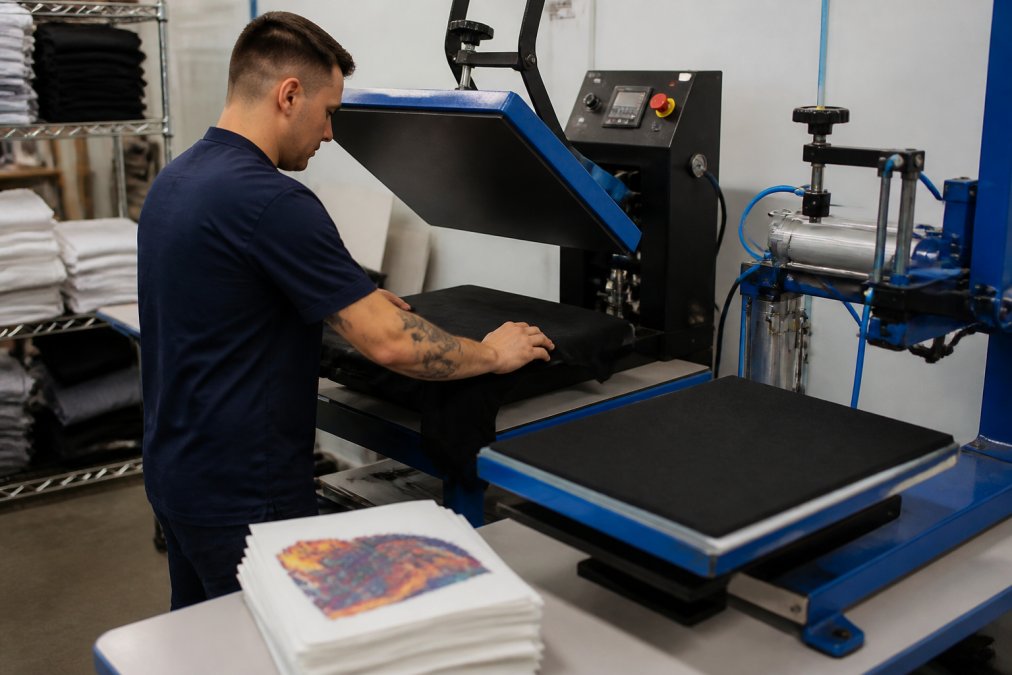
Heat press settings are where most apparel decoration problems are born: the two methods run on opposite ends of the temperature and time spectrum, so one press profile will not serve both.
Why the Two Profiles Are So Far Apart
DTF is a surface-bond process: the adhesive powder must reach activation temperature, flow into the weave, and cool into a mechanical lock. Too cool and the powder never melts; too hot and the film scorches or the adhesive wicks past the ink edge, creating a halo.
Pressure, Peel, and the Variables That Actually Bite
For DTF, transfer temperature, dwell time, and pressure settings must all be consistent. A pneumatic press holds pressure more evenly than a manual one across a full shift. The Audley Dual-Station Pneumatic Heat Press 16" × 24" uses compressed air for repeatable pressure and a two-workstation design, so one garment presses while the next is loaded.

Troubleshooting the Failures You Will Actually See
Know what each failure looks like and which variable to change first.
- Cracking along the print edge after washing. Usually under-cured adhesive or too little pressure. Raise dwell time by 2-3 seconds before touching temperature.
- Peeling in sheets, not at the edges. Almost always a pressure problem. The adhesive never fully wet out the fabric weave. Check that the press is level and the platen is not bowed.
- Dull or washed-out DTF color on dark garments. The white ink layer is too thin, or the transfer was pressed too hot and the white migrated. Re-check the white ink channel and lower temperature slightly.
- Sublimation print looks faded after three washes. Dwell time was too short, or the polyester content is below the practical floor. Confirm fiber content before blaming the press.
- Ghosting or double image on sublimation. The paper shifted during pressing. Tape the transfer down or use a tack spray.
- Yellowing on white polyester after sublimation. Too much heat or too long a dwell. Back off both and re-test.
Matching Settings to Your Press, Not a Chart
Every press has its own personality. A manual clamshell runs cooler at the edges than the center; a pneumatic swing-away holds temperature more evenly but recovers slower. Published settings assume a calibrated press, and most shop presses drift a few degrees over a shift.
Roland S-PG DTF Inks 220ml for BN-20D →
DTF Printer Maintenance Tips and Sublimation Upkeep
DTF printers need daily attention; sublimation printers need less frequent but more thorough care.
- Agitate white ink cartridges or pouches before each shift
- Print a nozzle check every morning
- Clean the capping station weekly
- Keep humidity in the 40-60% range to slow ink drying
- Replace dampers at the first sign of inconsistent flow
Equipment, ROI, and Scaling Your Apparel Business
Scaling changes the math: the method that wins at 20 shirts per week is not always the one that wins at 500. Cost per print is the least useful number for a growing shop, what matters is cost per sellable garment, throughput per labor hour, and revenue from orders you can actually accept.
The Real Equipment Bill
A DTF setup requires a printer, a shaker or curing oven, and a heat press. Entry-level printers run in the low thousands, but the shaker and press are not optional, you cannot cure adhesive powder with a heat press alone at production speed. Budget for the full line.
Payback Math That Actually Holds Up
ROI hinges on use: a DTF printer running four hours a day pays back faster than a sublimation setup running one shift a week, even at a higher cost per print. Consumables matter too. Direct To Film 13" x 19" Insta-Peel 100 Sheets ($65.00) peel immediately after pressing, removing a cooling wait from every cycle.

The Hybrid Workflow Most Shops Eventually Adopt
Established shops usually run both methods side by side, because they serve different product lines.
- Sublimation for all-over-print polyester, performance wear, jerseys, and hard goods like mugs, tumblers, and phone cases.
- DTF for cotton tees, hoodies, dark garments, blends, and any order that needs to ship without a minimum.
- Both when a customer orders a mixed catalog, a sublimated jersey and a DTF-printed hoodie in the same shipment.
A Decision Framework for Scaling
Use this sequence when deciding where to invest next:
- What is your current order mix? More than 60% cotton or dark garments means DTF is the priority; more than 60% polyester performance wear or hard goods means sublimation is.
- What is your rejection rate? A high rate usually means a process problem, not an equipment problem. Fix the process before buying more gear.
- What is your labor cost per unit? DTF's immediate peel and no-weeding workflow usually wins for small runs; sublimation wins for long runs of the same design.
- What is your cash conversion cycle? DTF lets you accept, print, and ship an order the same day. Sublimation often requires blanks in stock, tying up cash.
- What is your growth path? DTF's substrate flexibility protects a growing catalog; sublimation's throughput rewards going deep on one category.
Where the Money Actually Comes From
The shops that scale are not the ones with the cheapest cost per print, they are the ones that can say yes to more orders without adding headcount or inventory. DTF's on-demand printing across fabric types is a revenue tool; sublimation's all-over-print polyester speed is a margin tool for a focused catalog.
Conclusion
Choosing between DTF and sublimation is really a question about your customer base. Sublimation rewards a focused polyester product line and high volume; DTF rewards shops that need to say yes to any fabric, any color, and any order size.
Frequently Asked Questions
Can DTF transfers be applied to 100% cotton shirts?
Yes. DTF transfers bond to cotton, cotton blends, polyester, and dark garments using a hot melt adhesive powder and heat press. This is the main advantage over sublimation, which requires light-colored fabric with over 65% polyester content (DTF Station Global, 2026). If your shop prints mostly cotton tees, DTF is the more flexible choice.
Which lasts longer, DTF or sublimation?
Sublimation typically wins on durability because the ink bonds directly into the fibers, creating a zero-feel print that resists cracking and fading (Gelato, 2026). DTF prints sit on top of the fabric and can wear differently over time, though proper curing and heat press settings extend wash durability significantly. For performance wear washed frequently, sublimation holds up better.
Is DTF more expensive than sublimation?
Sublimation costs $0.75 to $2.50 per print, while DTF runs $1.50 to $4.00 per print (DTF Virginia, 2026). However, DTF delivers 30-50% lower per-unit cost than DTG for small-to-medium runs (Inkbank, 2026), and it works on fabrics sublimation cannot touch, which often makes it the better value for mixed orders.
What are the disadvantages of DTF printing?
DTF prints have a distinct hand feel because they sit on top of the fabric rather than dyeing it (Printful, 2026). The process also requires a shaker system, hot melt adhesive powder, and curing oven, adding equipment and maintenance steps. Print head clogging is a real concern, so regular maintenance cycles matter more than with sublimation.
What fabric types are best suited for sublimation printing?
Sublimation works best on light-colored polyester and synthetic fibers with over 65% polyester content (DTF Station Global, 2026). Performance wear, jerseys, and all-over print garments are ideal because the ink bonds into the fibers for a zero-feel finish. Cotton and dark fabrics are not compatible, which limits sublimation to specific product lines.


