

Table of Contents
- Heat Press vs Screen Printing: Quick Comparison for Small Startups
- Setup Costs and Upfront Investment
- Heat Transfer vs Screen Printing Cost Analysis
- Choosing a Reliable Heat Press for Small Business
- Best Screen Printing Press for Beginners
- Production Speed, Quality, and Space Requirements
- Scaling a Custom Apparel Business: Hybrid Workflows and Growth
- Frequently Asked Questions
Last Updated: September 30, 2026
Heat Press vs Screen Printing: Quick Comparison for Small Startups
Heat press vs screen printing for small startups comes down to one number: how much you spend before the first shirt sells. Heat press methods have almost no setup cost, which makes them the economical choice for small-batch production runs, according to MFG Merch's 2026 comparison of startup equipment overhead. Screen printing charges a fixed setup fee per color, so it only wins as order volume climbs. At McLogan, we've watched this play out in thousands of shops since 1922, and the pattern rarely changes.

The short answer: start with heat-applied graphics, add a manual press when reorders justify it.
Factor |
Heat Press |
Screen Printing |
|---|---|---|
Setup cost |
Near zero |
Per-color setup fee |
Best run size |
1-50 units |
36+ units |
Training time |
Hours |
Weeks |
Print feel |
Sits on fabric |
Integrated into fabric |
Space needed |
2-3 sq ft |
20+ sq ft |
Setup Costs and Upfront Investment
Startup capital is where heat press wins decisively. A Stahls Hotronix Maxx Clam Shell Heat Press runs $850.00 at McLogan, and it's simple to use and portable, with a wide opening for easy layout on t-shirts and left chest logos. That's a complete production setup for under a thousand dollars.
Screen printing demands more: a press, one screen per color, emulsion, ink, and a curing setup. The Stahls operational efficiency analysis notes that heat printing eliminates screen-related labor and setup time entirely, which is exactly why low-volume shops avoid the upfront hit.

Heat Transfer vs Screen Printing Cost Analysis
Heat transfer vs screen printing cost analysis usually ends at break-even volume, but the number that actually matters for a startup is cost per sellable unit, including the units you print and never sell. That second figure is where the two methods diverge hardest, and most comparisons ignore it.

Start with the mechanics. Screen printing charges a fixed setup per color per design: you burn a screen, register it, and run the full quantity in one pass. Heat-applied graphics carry no per-color setup, you cut vinyl or print a transfer, then press each garment individually. The Stahls operational efficiency analysis notes that heat printing eliminates screen-related labor and setup time entirely, which is exactly why low-volume shops avoid the upfront hit.
Run the math on a 24-piece team order with three colors:
- Screen printing: three screens, three setups, one production run. Per-unit ink cost is low, but the setup is spread across only 24 pieces, so each shirt carries a disproportionate share of the fixed cost.
- Heat press: cut or print the transfer once, then press each garment in about a minute. No per-color setup, so the 24th shirt costs roughly the same as the first.
That flat cost curve is the real advantage. Heat press labor stays consistent regardless of quantity, which gives small startups predictable margins, per Stahls' 2026 operational efficiency analysis. Screen printing inverts this: cheap per unit at 500 pieces, expensive at five.
Run size |
Screen printing cost behavior |
Heat press cost behavior |
|---|---|---|
1-24 units |
Setup dominates; per-unit cost is high |
Flat per-unit cost; no setup |
25-99 units |
Depends heavily on color count |
Still flat; labor-bound |
100+ units |
Per-unit cost drops sharply |
Flat; labor becomes the ceiling |
Reorders |
Wins if screens are stored and reused |
Wins only if the transfer file is reused |
The cost competitors leave out: dead inventory. Screen printing rewards volume, so the cheapest per-unit price pushes you to print more than you can sell. Every unsold shirt is a sunk cost that raises your true cost per sold unit. Heat-applied graphics let you press on demand, print transfers as orders arrive, not in a bulk run, so you carry far less dead stock. For a startup still guessing at demand, that inventory risk is often a bigger line item than the ink itself.
Choosing a Reliable Heat Press for Small Business
A reliable heat press for small business needs three things: even pressure, accurate temperature, and a platen sized to your typical job. The Stahls Hotronix Maxx Clam Shell Heat Press delivers all three at $850.00, with a patented Over-the-Center Pressure Adjustment that applies even, edge-to-edge heat regardless of substrate thickness.
Its digital time and temperature display keeps results consistent across operators, and the clam shell design saves space in a home studio. Three sizes are available, plus four optional interchangeable platens for small logos and sleeves.
Riley Hopkins 250+ Screen Printing →
Best Screen Printing Press for Beginners
The best screen printing press for beginners is a small manual press that lets you learn registration without a large investment. The Riley Hopkins 150 Screen Printing Press at $274.95 is a durable, versatile option for starting a side business or handling live printing events. It accepts different platens, so it prints on various apparel types without breaking the bank.
When multi-color work becomes routine, step up to the Riley Hopkins 250+ Screen Printing Press with XY Micro Registration at $1,459.95. Built in the USA with durable steel construction, it adds a heavy-duty Dual-Bearing Gate that locks the printhead into stable alignment, plus XYZ micro registration with tilted micros for dialing in tight multi-color jobs.
Production Speed, Quality, and Space Requirements
Space requirements separate these methods more than most guides admit. A heat press needs 2-3 square feet and runs on a standard outlet. A four-color screen printing setup with a flash dryer and curing station can consume an entire garage bay, and the curing step alone often needs ventilation or a dedicated circuit that a home studio may not have. That footprint difference is why so many startups begin with heat-applied graphics and add a manual press only when reorders justify the floor space.
Production speed depends on the job, not the machine. Heat-applied graphics allow faster turnaround on last-minute team orders and small event runs compared to traditional screen setups, per Screen Printing Magazine's 2026 report on print shop competitiveness. Staff can be trained on a heat press in hours rather than the weeks screen printing requires. But screen printing wins the moment a job repeats: once screens are burned and registered, a manual press can pull a finished shirt every few seconds, while a heat press is capped by one press cycle per garment.
On print quality, screen printing still wins for high-wear, high-volume garments. Plastisol ink bonds into the fabric for a softer hand feel and greater wash durability.
Scaling a Custom Apparel Business: Hybrid Workflows and Growth
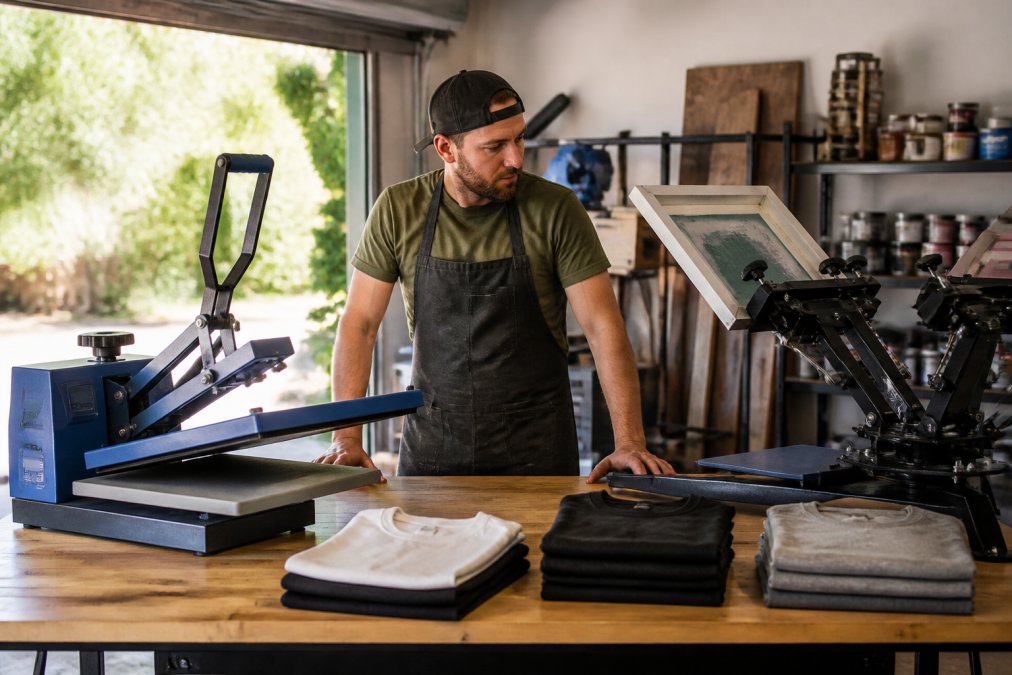
Two angles most comparisons skip. First, resale value: Riley Hopkins presses hold value well because the chassis is steel and expandable, with select 250+ models upgrading from 2-station to 4-station configurations via bolt-on kits. Second, sustainability: heat transfer vinyl produces less ink waste and no screen cleaning chemicals, which matters as more buyers ask about production practices.
Frequently Asked Questions
Is a heat press or screen printing more profitable for a new business?
For small startups, heat press often wins on profitability in the early months because it has almost no setup cost per order. Screen printing adds a fixed setup fee for each color, which only pays off at higher volumes. If most of your orders are under a few dozen pieces, a heat press keeps your cost-per-print predictable and your margins healthy.
What are the main differences between Stahls heat presses and Riley Hopkins screen printing presses?
Stahls heat presses apply heat transfer vinyl or DTF transfers using controlled temperature, pressure, and dwell time. They need no screens, emulsion, or curing setup. Riley Hopkins screen printing presses, like the 250+ or 150, use mesh screens and plastisol ink to print directly onto garments. Screen printing gives a softer hand feel and better durability on large runs, but each color needs its own screen and setup.
How much space do I need for a screen printing setup versus a heat press?
A heat press like the Stahls Hotronix Maxx needs only a sturdy table and a few feet of clearance, making it practical for a home studio or spare room. A screen printing setup needs room for a press, screens, a washout sink, a drying rack, and ink storage. The Riley Hopkins 250+ is built for garage shops and small production spaces, but you still need more floor area than a heat press alone.
Which printing method is better for small-batch custom apparel?
Heat press is usually better for small batches because it skips screen setup fees and handles one-off or last-minute orders quickly. Screen printing becomes more cost-effective as order volume grows and the same design repeats. Many startups use a heat press for samples and small runs, then move to a screen printing press once a design sells consistently.
Can a startup use both heat press and screen printing equipment?
Yes, and many growing shops do. A hybrid workflow uses a screen printing press like the Riley Hopkins 250+ for bulk orders and a heat press like the Stahls Maxx for small runs, names, numbers, and last-minute team orders. This combination lets you capture both high-volume and niche work without turning away customers.


