

Last Updated: November 8, 2026
Quick Summary
A swing away heat press is worth it when full access to the lower platen reduces misprints and speeds up alignment-sensitive or bulky work more than the extra clearance and slower cycle cost you. If your space is tight and you run high-volume flat garments, a clamshell usually serves you better.
- Swing-away presses lift and rotate the heated platen clear, while clamshells open straight up and stay overhead.
- Measure the swing radius from the pivot to the platen's far edge and tape that arc before ordering.
- A 16x20 platen sweeps a larger arc than a 15x15, so it demands more clearance.
- Divide the price gap by your weekly redo cost to find the swing-away break-even point.
- Hinge wear, spring tension, and platen alignment are the long-term wear items to check.
Table of Contents
- Swing-Away vs. Clamshell Heat Press: Which Opens Up Your Workflow?
- How to Measure Workspace Clearance Before You Buy
- Swing-Away Heat Press 16x20: Sizing Up the Standard Production Footprint
- The Best Slide-Out Heat Press Setup for Growing Shops
- Pressure, Safety, and Thick Substrates: What Swing-Away Changes
- Total Cost of Ownership: When a Swing-Away Press Pays for Itself
- Choosing Your Swing-Away Heat Press at McLogan
- Frequently Asked Questions
Swing-Away vs. Clamshell Heat Press: Which Opens Up Your Workflow?
Whether a swing-away heat press is worth it comes down to one question: does moving the upper platen out of your way save more time than the extra footprint costs you?
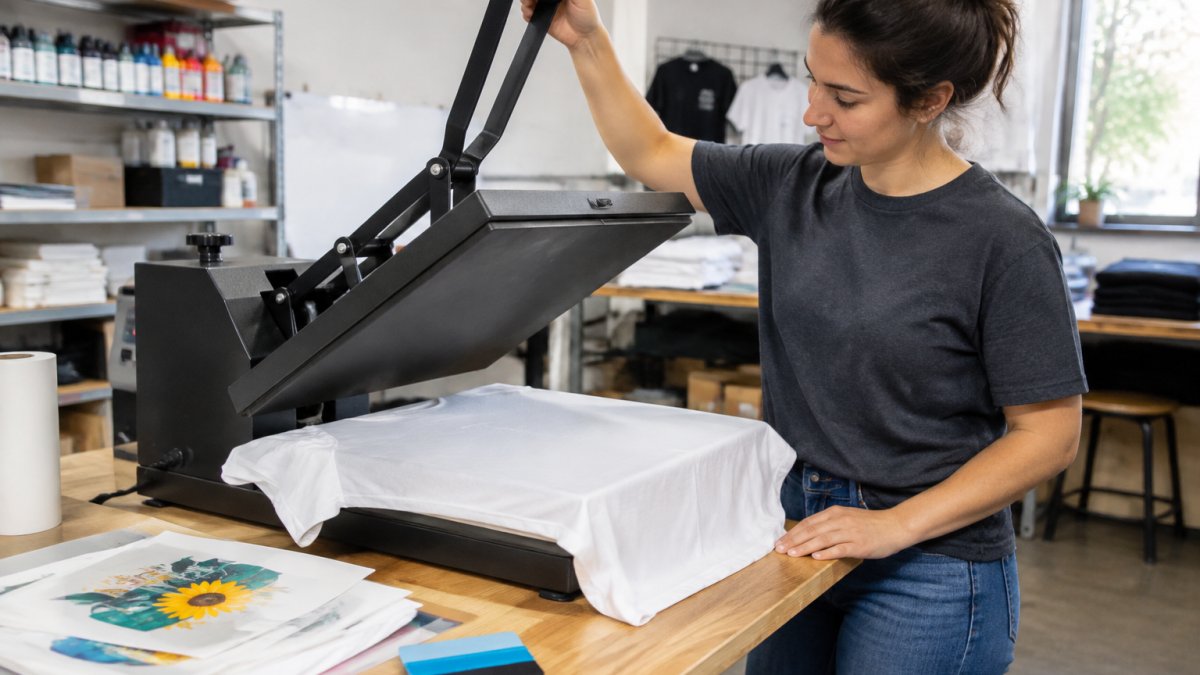
A swing-away heat press is a transfer machine where the top heating platen swings on an arm away from the work area, giving the operator unobstructed access to the lower platen for loading and unloading. The design trades floor space for visibility and clearance.
(/products/vector-15-x-15-swing-away-heat-press) pairs the open loading area with an adjustable pressure knob and a secondary use handle.How to Measure Workspace Clearance Before You Buy
Measure the swing arc, not just the machine. A swing-away press needs clear floor or bench space for the platen to travel through, plus room for the operator to stand and load.
Start with three measurements, in this order:
- Platen size. A 15" x 15" platen and a 16" x 20" platen do not need the same clearance. The larger platen sweeps a larger arc, and the arm length grows with it.
- Swing radius. With the platen fully open, measure from the hinge or pivot point to the far edge of the heated platen. That distance is the radius of the arc the platen travels through. Mark that arc on your bench or floor with painter's tape before you order anything.
- Operator zone. Add standing room on the loading side, roughly arm's length plus a step, so you can step back while the platen swings. If you share the station, size for the tallest operator.
A common pattern in small shops is a press that fits the bench but not the room: the platen clears the bench, then clips a shelf, a wall, or a second machine at the top of its arc.
Run this checklist before ordering:
- Measure the platen's swing radius and mark that arc on your bench with tape
- Confirm nothing (shelves, walls, other equipment, overhead cabinets) sits inside the arc
- Check the height of your table against your natural working posture, the lower platen should sit near elbow height when you load
- Leave standing room on the loading side, roughly arm's length plus a step
- Confirm the swing travels to your side, not across your body, so you never reach over heat
- Test the reach to the pressure knob and controls without leaning across the platen
Ergonomics matter as much as raw clearance. If you must twist or reach across a hot platen to adjust pressure, the layout is wrong.
Swing-Away Heat Press 16x20: Sizing Up the Standard Production Footprint
A 16x20 platen is a larger production size that covers full-front and full-back garment prints in one press. That larger platen also means a larger swing arc, so a 16x20 swing-away demands more clearance than a 15x15.
The TITAN Pro 16" x 20" Auto Open Swing Away Heat Press, priced at $1,799.00, offers a 16" x 20" working area, a touchscreen control with pressure detection and three memory presets, and supports flex, flock, sublimation, and DTF transfers. The auto-open function lifts the platen on its own at the end of the cycle.

If your work leans toward smaller goods, ornaments, or name plates, a 15x15 covers most of it and takes less room. Match the platen to your largest regular job, not your smallest.
The Best Slide-Out Heat Press Setup for Growing Shops
A slide-out setup pulls the lower platen toward the operator instead of swinging the upper platen away. For shops adding staff or stations, it can be the better fit because the movement stays within the machine's own footprint.
So which do you choose? If your bottleneck is alignment and thick goods, swing-away wins. If your bottleneck is floor space and repeat speed on flat garments, a slide-out or clamshell layout usually serves you better.
Plan the station around the workflow, not the machine alone. Keep transfers within reach, stage finished pieces away from the heat, and leave a clear path for the platen to travel.
Pressure, Safety, and Thick Substrates: What Swing-Away Changes
Pressure consistency decides transfer quality more than any other setting. On a swing-away press, the platen comes down with true vertical pressure, so the force lands evenly across the substrate rather than at an angle.
That even contact matters most on thicker, harder substrates.
Safety deserves a mention too. If pressure or temperature issues show up mid-run, our guide to heat press machine troubleshooting walks through the common fixes.
Watch out: reaching across a partially swung platen to nudge a shirt is the most common burn in a busy shop. Load only when the platen is fully clear.
Total Cost of Ownership: When a Swing-Away Press Pays for Itself
A swing-away press pays for itself when reduced misprints and faster specialty work outweigh the higher upfront price. The math is simple in structure, even if the numbers are yours: count the pieces you redo each week from alignment errors, add the labor and material, and compare that recurring cost to the one-time price gap between a clamshell and a swing-away.
Separate the costs into two buckets so the comparison stays honest.
One-time costs
- Purchase price of the press itself, swing-away machines carry a higher sticker than basic clamshells
- Any accessories the workflow needs: extra platens, a stand or table rated for the press weight, a heat-resistant mat, transfer sheets
- Setup and training time for staff who are new to the swing motion
Recurring costs
- Redo rate: every misaligned transfer wastes vinyl, a garment, and the labor to press it twice. Track how many pieces you redo in a typical week and what each one costs you in materials and minutes.
- Throughput: flat-garment runs favor clamshells because there is no swing out and swing back; specialty, bulky, and alignment-sensitive work favors swing-away because the open platen reduces redo rate. The right question is which cost dominates in your mix.
- Maintenance and parts: hinge wear, spring tension, and platen alignment are the long-term wear items on a swing-away. Ask about replacement hinge and spring availability and warranty coverage before you buy.
- Downtime: a press that stops mid-season costs more than its price gap. The dual-breaker design on the TITAN Pro is intended to maintain protection and continued operation if one breaker becomes inoperative.
A simple break-even test: divide the price gap between the two presses by your weekly redo cost. The result is the number of weeks it takes for the swing-away to pay back the difference through fewer misprints alone. If that number is shorter than how long you expect to keep the press, the swing-away is the cheaper machine over its life, even though it costs more on day one.
Durability belongs in the calculation too. For a deeper look at matching equipment to volume, read what is the best heat press for high volume production.
Choosing Your Swing-Away Heat Press at McLogan
At McLogan, we have supplied screen printing and heat transfer equipment since 1922. If you are a small business scaling up, our reliable heat press for small business guide helps you pick a machine that still makes sense after you grow.
Ask three questions before you buy: What is my largest regular substrate? How much clear space can I dedicate to the swing arc? How many pieces per day must this press turn out? The answers point to either a swing-away or a clamshell without much debate.
A swing-away heat press is worth it when alignment, thick substrates, and operator safety matter more to your shop than raw cycle speed and floor space.
Frequently Asked Questions
Is a swing-away heat press better than a clamshell press?
It depends on your space and what you press. A swing-away heat press moves the upper platen completely away from the loading area, so you get full access to the lower platen for aligning heat transfer vinyl, DTF transfers, or screen print curing. Clamshell presses open upward and take less floor space. If you press thick or bulky items, need precise alignment, or run varied orders, swing-away usually wins. If your workspace is tight and you mostly press flat garments, a clamshell can do the job.
What are the main disadvantages of a swing-away heat press?
The biggest trade-off is workspace clearance. The swinging motion needs room beside the press, so a small table or crowded corner may not fit one. Swing-away presses can be slower per press if your operator has to swing the platen back and forth on every cycle. The heated platen also travels through the air, so you need to keep hands and clutter clear of its path. None of these are dealbreakers, but they matter for tight shops.
How much workspace does a swing-away heat press need?
Plan for clearance on the side the platen swings toward, plus room in front for loading and unloading. A 16x20 swing-away press needs a sturdy table with enough depth to hold the base and enough side clearance for the platen to rotate fully without hitting a wall, shelf, or another machine. Measure the swing radius before you buy and leave a few inches of buffer. If your space is limited, a clamshell or a slide-out model may fit better.
Is a swing-away heat press suitable for a small business?
Yes, if your order mix includes thick items, bulky garments, or jobs that need precise alignment. A swing-away heat press gives you full access to the lower platen, which speeds up loading and helps with consistent results on varied substrates. For a shop just starting out with limited space, a smaller clamshell may be the safer first buy. As order volume grows, a 16x20 swing-away with adjustable pressure and even heat distribution becomes a practical upgrade.


