

Table of Contents
- Screen Printing vs DTF Printing: Which Method Fits Your Shop?
- How Each Method Works: Screen Printing and Direct-to-Film
- DTF vs Screen Printing for Small Orders
- Screen Printing vs DTF Print Quality: Detail, Color, and Hand Feel
- DTF vs Screen Printing Durability: Wash Resistance and Cracking
- DTF Printing Equipment and Screen Setup: What Each Method Requires
- Cost Per Shirt and the Real Break-Even Point
- Frequently Asked Questions
Last Updated: October 7, 2026
Screen Printing vs DTF Printing: Which Method Fits Your Shop?
Screen printing vs DTF printing comes down to one question: how many pieces of the same design are you running?

Screen printing is a stencil-based process that pushes plastisol or water-based ink through a mesh screen onto fabric. DTF printing is a digital process that prints pigment ink onto a PET film, coats it with adhesive powder, and heat-presses the transfer onto the garment.
That's the theory. Here's what actually happens when you run both.
How Each Method Works: Screen Printing and Direct-to-Film
The two processes diverge at the very first step: one builds a physical stencil, the other sends a digital file straight to a printer. Everything downstream, cost, speed, and feel, follows from that split.
Screen Printing: Screens, Mesh, and Plastisol Ink
Screen printing starts with artwork separation. Each color needs its own screen, mesh count, emulsion coating, exposure, and washout.
Plastisol ink sits on top of the fabric rather than soaking in, which is why screen-printed shirts hold bold color so well.
Setup is the trade-off. Once the screens are burned and registered, a press can run hundreds of identical prints per hour.
DTF Printing: Film, Pigment Ink, and Adhesive Powder
DTF skips screens entirely. You print the design in mirror mode onto PET film, apply hot melt powder, cure the powder, then transfer with a heat press. No color separation, no emulsion, no mesh.
A one-off job costs almost nothing in setup, and DTF handles gradients, photographs, and 12-color artwork that would be impractical to separate onto screens.
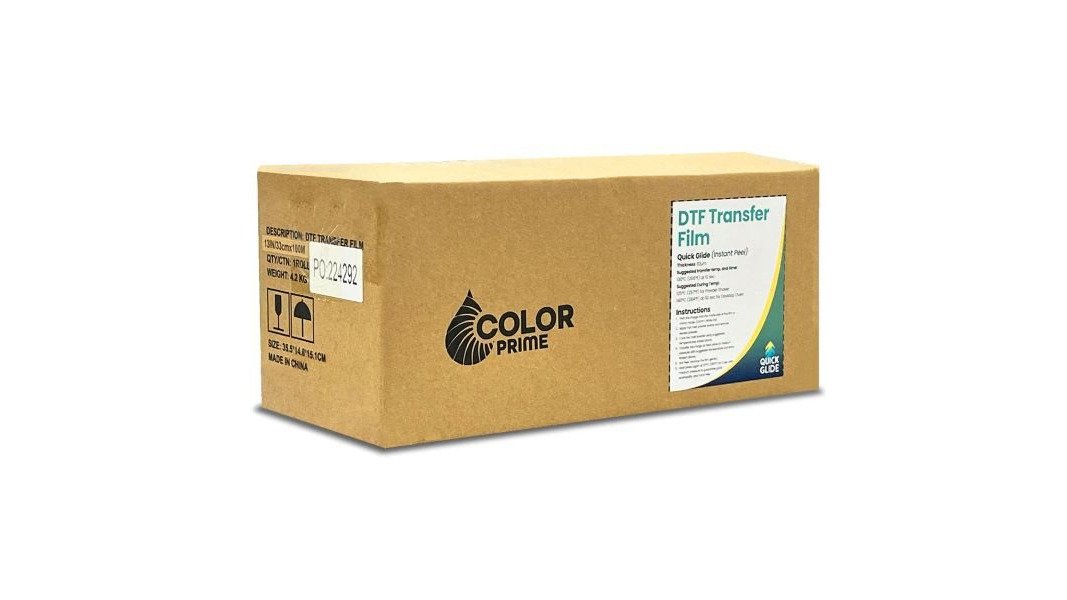
Peel behavior varies by film. Instant-peel films like our Color Prime Glide DTF Film Roll let you peel straight off the press, which matters when you're running volume. For larger designs or shops testing DTF before committing to a roll, Direct To Film Insta-Peel Sheets in 13" x 19" give you the same instant-peel behavior in pre-cut form.


DTF vs Screen Printing for Small Orders
DTF wins small orders, and it isn't close. With no screens to burn, a 12-piece run costs only film, powder, ink, and press time. Screen printing that same run means burning four screens for four shirts each.
The UploadDTF comparison puts the DTF advantage at 20 to 40 percent for orders between 50 and 100 pieces.
Where small-order economics flip is repeat business. If a customer reorders the same design monthly, screen setup amortizes across the year and the per-unit math changes completely.
For shops running mixed work, the practical answer isn't either/or. Keep screens for repeat accounts and run DTF for the one-offs, samples, and personalization jobs that would otherwise eat your setup time.
Screen Printing vs DTF Print Quality: Detail, Color, and Hand Feel
Screen printing wins on hand feel. DTF wins on detail.
Screen-printed plastisol sits in and on the fabric with a soft, integrated finish, especially on thin deposits.
DTF leaves a slightly rubbery film layer on top of the fabric, according to discussion in the r/SCREENPRINTING community.
On detail, DTF runs away with it.
Color vibrancy is closer than most people expect.
| Factor | Screen Printing | DTF Printing | Winner |
|---|---|---|---|
| Hand feel | Soft, integrated | Slight film layer | Screen printing |
| Fine detail | Limited by mesh | Photographic quality | DTF |
| Color count | One screen per color | Unlimited | DTF |
| Dark garment opacity | Excellent with base plate | Good with high ink load | Screen printing |
| Setup per design | Screens, emulsion, registration | None | DTF |
DTF vs Screen Printing Durability: Wash Resistance and Cracking
Both methods hold up well when the transfer is done right, and both fail when it isn't.
Screen printing's failure mode is undercuring. Ink that doesn't reach full cure through the entire layer will crack and wash out, usually within a dozen cycles.
DTF's failure mode is powder application and press settings. Too little powder and the transfer peels at the edges.
The methodology that actually tells you which is better for your shop is wash testing.
DTF Printing Equipment and Screen Setup: What Each Method Requires
DTF printing equipment is a smaller upfront list than most people assume: a DTF printer, film, pigment ink, hot melt powder, a powder shaker or curing oven, and a heat press.
Color Prime Glide DTF Film Roll →
The capital gap is real, and it's the main reason new decorators start with DTF. A single-color manual press setup can start around the price of our Riley Hopkins 150 Screen Printing Press, but that's one piece of a system.
Where the workflow actually bottlenecks
Equipment lists tell you what to buy, not where your day gets stuck. Here's the bottleneck map for each method.
Screen printing workflow:
- Artwork separation and film output.
- Screen coating, exposure, and washout, this is per color, per design.
- Registration and test prints on press.
- Production run on press.
- Cure through the conveyor dryer.
The bottleneck is almost always steps 2 and 3. Burning and registering screens is skilled, sequential labor that can't be parallelized easily.
DTF workflow:
- Print design in mirror mode onto film.
- Apply hot melt powder and shake off excess.
- Cure the powder in an oven or shaker unit.
- Heat press the transfer onto the garment.
- Peel.
The bottleneck here is steps 4 and 5. Every piece needs its own press cycle, and peel behavior sets your pace.
What that means for throughput
Screen printing front-loads its labor: you pay a setup tax per design, then run cheaply. DTF spreads labor evenly across every piece, no setup tax, but every piece carries the same press-cycle cost.
That is why the two methods suit different order mixes:
- Repeat designs, large runs: screen printing wins because the setup tax is paid once and the run is cheap.
- One-offs, samples, personalization, mixed designs: DTF wins because there is no setup tax to recover.
Choosing equipment that matches your bottleneck
On the DTF side, the printer and heat press choices drive your throughput. If your bottleneck is the press cycle, automating that step is the highest-leverage upgrade you can make.
Screen printing's setup burden is per-design, not per-shop. Once the equipment is in place, adding a new design costs screens and time, not capital. If your bottleneck is screen burning, the fix is more screens and faster exposure, not a bigger press.
Cost Per Shirt and the Real Break-Even Point
The break-even point sits somewhere between 250 and 500 pieces, depending on your design and your shop's overhead. A ColDesi screen print vs DTF break-even analysis found DTF held only a narrow cost advantage at 250 shirts, essentially a tie.
Those ranges are useful, but they hide the inputs that actually move your number. Here's a transparent way to build a like-for-like comparison, with assumptions you can swap for your own figures.
Assumptions for the worked example
- Garment: 100 percent cotton tee, midweight.
- Print: one location, roughly 10" x 12".
- Screen printing design: four colors.
The cost inputs that matter
Screen printing, per design:
- Screens: one per color, so four screens. Each screen carries mesh, emulsion, exposure labor, and washout.
- Setup labor: registration and test prints before the run starts.
- Ink: plastisol or water-based, consumed per print.
DTF, per design:
- Film: one sheet or roll length per print.
- Pigment ink: consumed per print, scales with ink coverage.
- Hot melt powder: consumed per print.
How the lines cross
At low volume, screen setup dominates your cost per shirt because four screens and registration spread across a small run. At high volume, that setup amortizes to near zero and ink, labor, and press speed dominate, and screen printing's throughput wins.
DTF inverts this. Setup is effectively zero, so a 12-piece run costs only film, powder, ink, and press time.
A common pattern practitioners report:
- Under 50 pieces: DTF is usually cheaper, often by a wide margin, because screen setup is spread across very few units.
- 50 to 100 pieces: DTF still leads, in the 20 to 40 percent range per the UploadDTF comparison, but the gap narrows.
- Around 250 pieces: the two methods often converge to roughly a tie on simple designs.
Run your own numbers
- Count your screen setups. Multiply screens per design by your cost per screen, including emulsion and labor.
- Add your DTF consumables. Film, powder, and ink per print, plus press time.
- Divide by order size. Setup cost per unit falls as volume rises. Consumables stay flat.
Run this for your three most common order sizes and you'll know your answer in an afternoon. For one-color designs on light garments, screen printing crosses over earlier.
For plastisol work, our FN-INK Screen Printing Plastisol Ink is a non-phthalate, ready-to-use ink that cures at 260 degrees, keeping you below the dye-migration range on polyester and saving dryer time on every run.
Frequently Asked Questions
Which is better for small apparel orders, DTF or screen printing?
For small orders, DTF usually wins on cost and setup. Screen printing requires a screen for every color in the design, so a five-color logo on 12 shirts carries a setup cost spread across very few pieces. A 2026 comparison from UploadDTF reports DTF saves 20 to 40 percent at order sizes of 50 to 100 pieces. DTF also handles full-color artwork without color separation, which keeps short runs simple.
Does DTF or screen printing last longer?
Both hold up well when cured correctly, but they wear differently. A properly cured plastisol print bonds into the fabric and survives repeated washing without cracking. DTF transfers sit as a film layer on top of the garment, and a Reddit discussion in r/SCREENPRINTING notes that layer can feel slightly rubbery. Wash resistance on DTF depends heavily on full powder cure; under-cured transfers peel at the edges first.
Can DTF print full-color designs on dark shirts?
Yes. DTF prints CMYK plus a white ink layer in one pass, so full-color artwork works on dark garments without a separate white base screen. On dark cotton with screen printing, you typically print a white base plate first, which adds a screen and a flash step. That difference matters most on designs with gradients, photos, or many colors.
What equipment do you need for DTF printing?
A DTF setup needs a DTF printer, pigment inks, transfer film, adhesive powder, a powder application method, and a heat press. McLogan carries film options like the Color Prime Glide DTF Film Roll at $88.99 and Direct to Film Insta-Peel sheets at $65.00, plus presses such as the Riley Hopkins 150 at $274.95 for shops adding screen printing alongside DTF.
At what order size does screen printing become cheaper than DTF?
The commonly cited threshold is 500 or more pieces of one simple design, where screen printing becomes more cost-effective according to a 2026 UploadDTF comparison. A ColDesi break-even analysis at 250 shirts found only a narrow DTF cost advantage, close to a tie. Exact crossover depends on your screen count, ink cost, and labor rate.
The real challenge isn't picking a side, it's matching your equipment to the orders you actually take. McLogan has supplied decorating shops since 1922, and our team helps you choose presses, films, and inks that work together from day one. Whether you need a manual press to start or DTF films and powder to add digital to your lineup, we'll help you build a setup that still fits when you scale. Search our catalog and talk to our staff about your production mix.


