

Table of Contents
- What You'll Need to Start: Core Equipment Categories
- 1. Wide-Format Printer for Sign Shop Production
- 2. Vinyl Cutter for Sign Making and Precision Cutting
- 3. Essential Sign Making Tools for Daily Operations
- 4. Sign Shop Finishing Tools and Materials
- Workspace Setup and Equipment Compatibility
- Prioritizing Your First Purchases by Budget Stage
- Common Mistakes to Avoid When Equipping Your Shop
- Frequently Asked Questions
Last Updated: October 11, 2026
What You'll Need to Start: Core Equipment Categories
Starting a sign shop requires focused investment in essential equipment for new sign shops, including three categories: printing and cutting equipment, hand tools, and finishing supplies. Your choices depend on production volume, sign types, and budget.
A vinyl cutter and wide-format printer form the backbone of most operations, handling custom decals to large banners. Hand tools and application supplies complete your essential kit.
The challenge is choosing the right combination for your needs. A vinyl-lettering shop needs different tools than one producing full-color wraps.
1. Wide-Format Printer for Sign Shop Production
A wide-format printer prints full-color graphics onto roll media, enabling banners to vehicle wraps in-house. Print quality, speed, and material compatibility determine production capacity and margins.
Eco-solvent printers balance speed, durability, and versatility. The Demo Roland TrueVIS VG3 Printer Cutter combines printing and contour cutting in one 64-inch device, printing at 1,200 dpi and handling media up to 62.9 inches wide. The integrated cutter eliminates a separate machine, simplifying workflow.

The 7-inch touchscreen interface enables straightforward setup, and automatic media calibration reduces setup time between jobs.
Print-and-Cut Workflow Benefits
Print-and-cut technology eliminates intermediate steps: the machine prints and cuts in sequence, saving time, reducing waste, and improving registration accuracy.
For custom decals or die-cut graphics, the machine outputs perfect cuts in one pass. Without integrated cutting, you'd print, unload, reload, and manually align artwork.
The Roland VG3 supports multiple eco-solvent ink configurations, expanding from standard CMYK to light colors, orange, green, or white ink as demand grows.
2. Vinyl Cutter for Sign Making and Precision Cutting
A vinyl cutter (plotter) cuts precise shapes from adhesive vinyl without damaging the backing, using a small blade to trace outlines in design software.
Vinyl cutters range from 12-inch desktop models to 54-inch wide-format plotters. New shops starting with vehicle lettering and window decals typically need 24- to 54-inch cutters.
Integration between design software, cutter, and printer determines efficiency. Many shops use both a dedicated vinyl cutter and print-and-cut printer, dividing work by job type.
Contour Cutting vs. Traditional Plotting
Traditional plotting traces pre-designed shapes with precise blade adjustment to avoid cutting the backing liner. Contour cutting (print-and-cut) prints a full-color graphic first, then automatically detects registration marks and cuts along printed edges, eliminating manual alignment. For new shops, a dedicated vinyl cutter handles most vinyl work; add print-and-cut systems as production grows.
3. Essential Sign Making Tools for Daily Operations
Hand tools and consumables are essential equipment for new sign shops, driving daily production. Cutting tools, application supplies, and finishing materials transform raw materials into finished signs.
The Olfa Pro 9mm Stainless Steel Slide-Lock Utility Knife is a precision cutting tool with Japanese tool-grade steel that stays sharp longer, reducing blade changes. The auto-lock mechanism prevents accidental extension, improving safety.

The Orange Safety Ruler is a 32-inch aluminum ruler with curved finger guard and non-slip grip tape, preventing accidental cuts during high-volume cutting.
Cutting and Measuring Precision
Precision in cutting and measuring directly affects finished sign quality. Professional-grade tools maintain edge quality through production runs. A safety ruler prevents slipped blades and ruler movement that ruins cuts. Measuring tools should be accurate within 1/16 inch; a 32-inch ruler covers most vinyl lettering and decal work.
Application and Weeding Tools
Application tools transfer cut vinyl graphics onto substrates, walls, vehicles, windows, or other surfaces. Weeding tools remove excess vinyl (the negative space) from designs, leaving only the final graphic.
The Black Felt Squeegee is a poly-blended squeegee with industrial-grade felt that protects vinyl from scratching and marring during application.
The Rtape Application Tape 4075 RLA High Tack is the industry standard, picking up cut vinyl cleanly and transferring without wrinkling or tunneling. The RLA (lay-flat) adhesive prevents lifting during shipping or storage, solving common application tape problems.
4. Sign Shop Finishing Tools and Materials
Finishing transforms raw graphics into durable, professional-looking signs. Laminates protect printed graphics from UV fade and weathering. Grommets and banner tape reinforce large signs. Trimming and edge-finishing tools clean up production.
The Olfa TS1 Top Sheet Liner Cutter cuts through vinyl liners without damaging layers beneath. The retractable carbon steel blade resists corrosion and is essential for multi-layer vinyl or laminated graphics.
The Banner Tape 1 Inch x 72 Yards seams large banners and reinforces edges in-house, saving time and preserving profit margins.
The Roland Premium Matte Paper PMP is heavyweight matte inkjet media with high-opacity coating for vibrant colors and works seamlessly with the Roland VG3. The Orajet 3640 Soft Calendered PVC is a 3-mil printable vinyl for short- to medium-term applications, compatible with multiple ink types and durable for 4 years unprinted.

Workspace Setup and Equipment Compatibility
Your workspace layout determines production efficiency and safety. A well-organized sign shop positions the printer, cutter, and work table to minimize material movement and maximize throughput. Equipment compatibility, ensuring machines work together without manual intervention, reduces bottlenecks.
Demo Roland TrueVIS VG3 Printer Cutter →
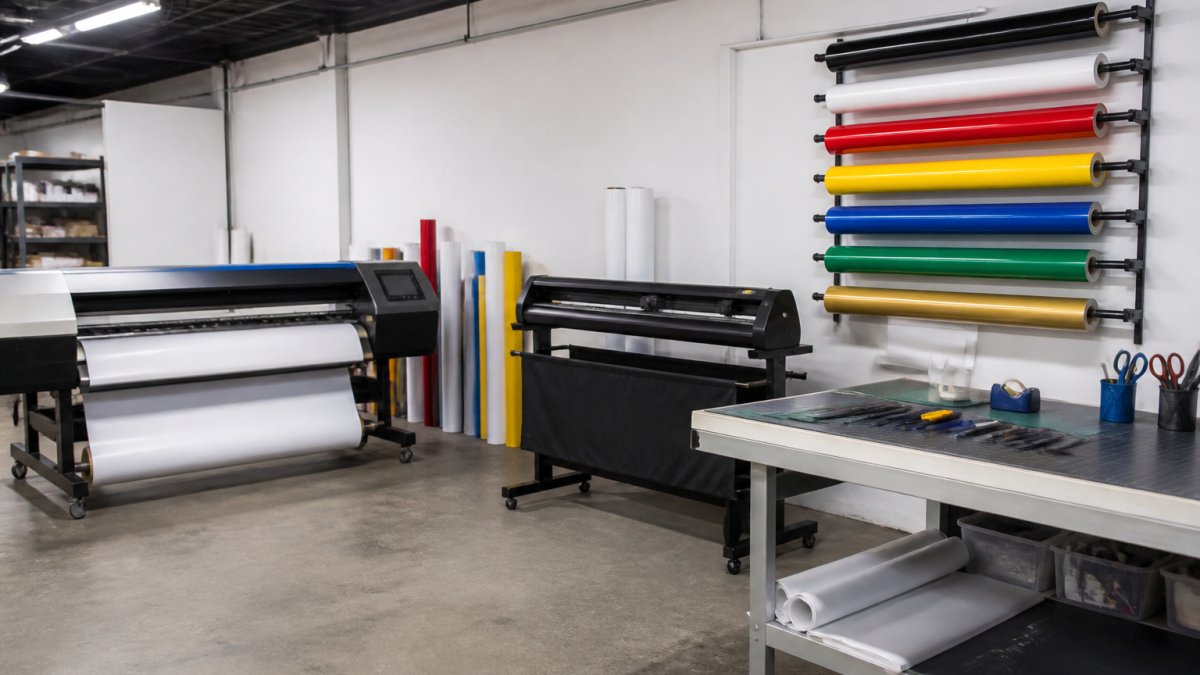
Start with a dedicated work table large enough to accommodate your largest substrate. A 4-by-8-foot table is standard for most shops. Position the table near the printer so you can load printed media directly onto the table for finishing. Keep your cutting tools, squeegees, and application tape within arm's reach.
The printer and cutter should be positioned to allow easy loading and unloading of roll media. Many shops arrange them in a line so material flows from storage, through the printer, to the cutter, and finally to the application table. This linear workflow reduces handling and errors.
Vertical storage for vinyl rolls saves floor space and keeps materials organized. The Vinyl Roll Holder Hanging Storage Over Door Or Wall Mount at $14.99 accommodates up to 24 rolls and mounts on a wall or over a door.
Equipment compatibility matters when integrating multiple machines. The Roland VG3 printer works with design software like VersaWorks (included with the machine), which also controls compatible vinyl cutters. This integration ensures that print-and-cut jobs align precisely without manual adjustment.
Prioritizing Your First Purchases by Budget Stage
Your equipment budget determines which tools you buy first and which you add later. A phased approach lets you start production quickly without overextending capital.
Budget Stage |
Total Investment |
Core Equipment |
Supporting Tools |
|---|---|---|---|
Minimum Viable Setup |
Under $5,000 |
Vinyl cutter, design software |
Hand tools, cutting mat, application tape |
Growing Operation |
$5,000-$15,000 |
Vinyl cutter + wide-format printer |
Laminator, finishing tools, vinyl storage |
Full Production Capability |
$15,000+ |
Print-and-cut system (Roland VG3) |
All finishing equipment, backup tools, expanded supplies |
Minimum Viable Setup (Under $5,000)
A new shop with a tight budget should prioritize a vinyl cutter and hand tools. A mid-range vinyl cutter (24-36 inches) costs between $2,000 and $4,000. Add the essential hand tools, utility knife, safety ruler, squeegee, application tape, and weeding tools, for under $100. Design software like CorelDRAW or Adobe Illustrator runs $20-$50 per month.
This setup handles vinyl lettering, decals, window graphics, and simple cut designs. You're limited to single-color vinyl or pre-printed substrates, but you can generate revenue immediately. Many shops start here and add a printer after their first profitable year.
The bottleneck at this budget level is production volume. Vinyl-only shops are slower than shops with print capability, so you'll have a longer turnaround for customer jobs. This is acceptable when starting but becomes limiting as demand grows. Diversifying your service offerings beyond simple vinyl applications allows you to capture higher-margin projects like quality custom engraving while simultaneously smoothing out the workflow inefficiencies inherent in entry-level production setups.
Growing Operation ($5,000-$15,000)
Once you're generating consistent revenue, add a wide-format printer. A mid-range eco-solvent printer (24-36 inches) costs between $3,000 and $8,000. This expands your capabilities to full-color printed signs, banners, and vehicle graphics.
At this stage, invest in finishing equipment: a basic laminator ($1,000-$2,000) protects printed graphics, and a grommet press ($500-$1,000) reinforces signs. These tools justify the printer investment by enabling professional finishes that command higher prices.
A growing shop also needs better workspace organization. A dedicated work table ($300-$500), vinyl storage system ($100-$200), and organized tool storage ($200-$400) improve efficiency and safety.
Full Production Capability ($15,000+)
A mature shop with consistent demand should invest in a print-and-cut system like the Roland VG3 ($7,995). This single machine replaces separate printer and cutter, reducing floor space and simplifying workflow. The integrated cutter ensures perfect registration for complex multi-color designs.
At this budget level, add redundancy: a backup vinyl cutter ($2,000-$4,000) ensures you can handle volume spikes without downtime. A professional laminator ($2,000-$4,000) handles larger substrates and expands finishing capabilities.
Invest in inventory: stock common vinyl colors, application tapes, and laminate films. A well-stocked shop reduces lead times and improves customer satisfaction. Budget $1,000-$2,000 for initial inventory, then replenish based on sales patterns.
Common Mistakes to Avoid When Equipping Your Shop
New sign shop owners often make purchasing decisions that limit growth or waste money. Understanding these pitfalls helps you invest strategically.
Buying too small too soon. A 24-inch vinyl cutter seems adequate when you're starting, but you'll outgrow it within a year if business grows. A 36-inch or 54-inch cutter handles more job types and larger designs.
Skipping the printer. Many new shops rely entirely on vinyl, assuming a printer is a future upgrade. But full-color printed graphics command higher prices and open new market segments (vehicle wraps, POP displays, large banners).
Choosing incompatible equipment. A vinyl cutter and printer from different manufacturers may not integrate smoothly. Design software for one machine may not control the other. Before purchasing, verify that your cutter, printer, and design software work together.
Underestimating consumable costs. Vinyl, application tape, laminate, and other supplies are ongoing expenses. Budget 15-20% of revenue for consumables. A shop that underestimates these costs will find margins squeezed and cash flow tight.
Buying the cheapest tools. A $5 utility knife dulls quickly and produces rough cuts. A $30 professional knife stays sharp longer and reduces blade changes. Over a year, the professional tool saves money and produces better results.
Neglecting workspace safety. A cluttered workspace with dull tools and poor lighting increases injury risk. Invest in proper lighting, organized tool storage, and safety equipment like the Orange Safety Ruler.
Starting a sign shop requires thoughtful equipment selection, but the investment pays off quickly. A vinyl cutter and wide-format printer form the foundation of most operations, supported by essential hand tools and finishing supplies.
Frequently Asked Questions
What's the absolute minimum equipment I need to start a sign shop?
At minimum, you need a vinyl cutter or plotter, cutting tools (safety ruler, utility knife, weeding hook), application tape, squeegees, and a work surface. Many shops start with manual cutting and hand application before adding a digital printer. A basic setup can start under $2,000, though adding a wide-format printer increases capability significantly and typically costs $7,000–$12,000 for entry-level models.
Do I need a wide-format printer for sign making from day one?
No. Many successful sign shops start with vinyl cutting only and outsource printing initially. A wide-format printer for sign shop production becomes essential when you're handling jobs that require full-color graphics, vehicle wraps, or custom decals. If you're doing simple cut vinyl lettering and logos, you can defer this investment until demand justifies it.
How do I know if equipment will work together in my workflow?
Check media compatibility across your vinyl cutter, printer, and application tools. For example, the Demo Roland TrueVIS VG3 Printer Cutter handles contour cutting and printing in one pass, reducing workflow steps. Verify that your design software exports to your cutter's format, your printer accepts your chosen vinyl or media, and your application tape works with your substrate. McLogan's team can help verify compatibility before you buy.
What sign shop finishing tools should I buy to protect my work?
Essential finishing tools include application tape (like R-Tape 4075 RLA for holding vinyl during installation), squeegees with felt edges to prevent scratching, and liner cutters for clean removal. For longer-lasting outdoor graphics, many shops add laminators. Grommets and banner tape let you finish large banners in-house, reducing outsourcing costs.


